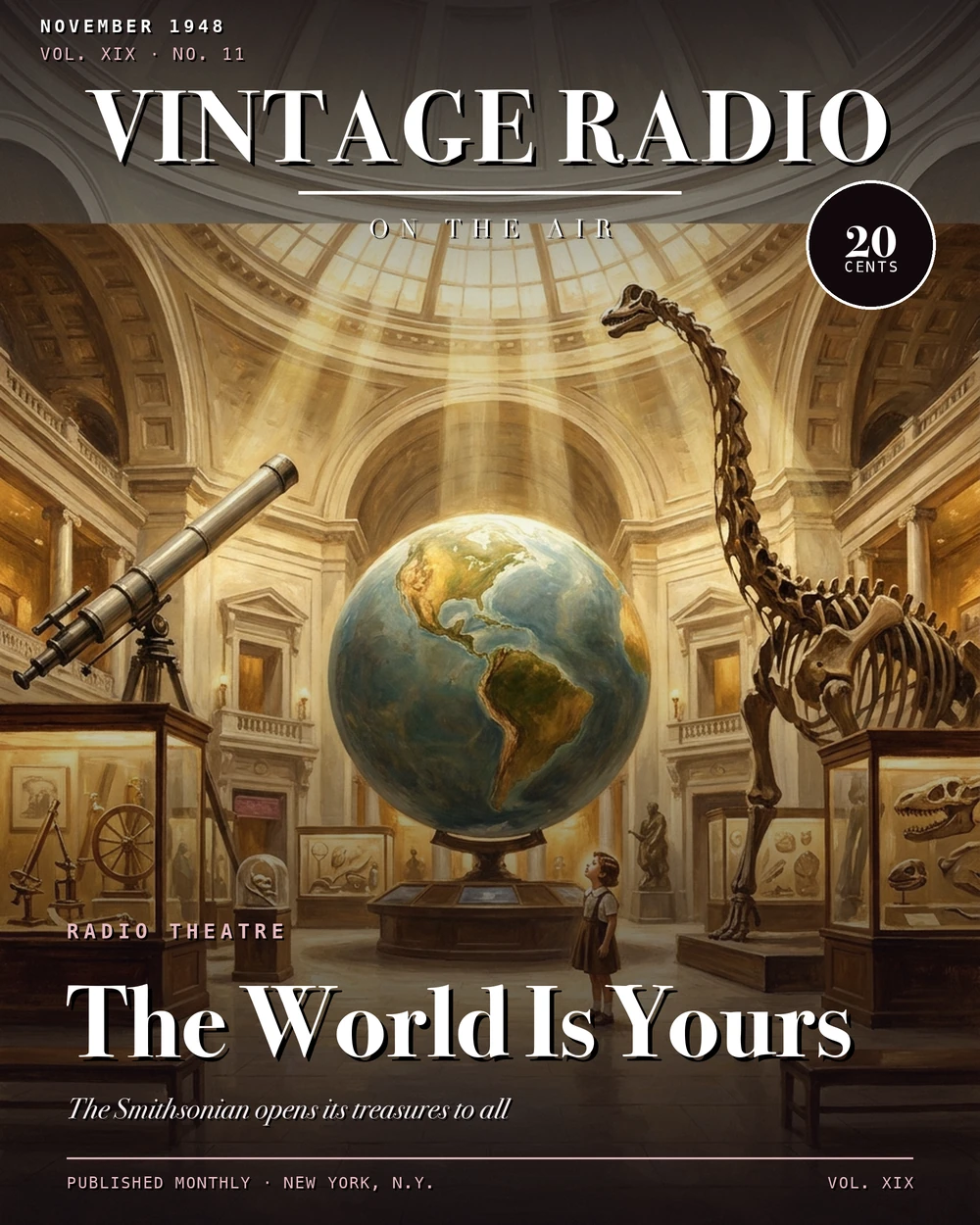
The World is Yours
The Show That Put the Smithsonian on the Radio
The World is Yours was the first radio program ever produced by the Smithsonian Institution, and that distinction alone sets it apart from everything else in the old-time radio catalog. It premiered on NBC's Blue Network on June 14, 1936 — a Sunday afternoon broadcast that kicked off six years and 303 episodes of science, natural history, geography, and historical drama. Nothing quite like it had been attempted at that scale before: a major federal research institution, with the backing of New Deal funding, using network radio to bring its collections and expertise into living rooms across the country.
The project was the result of deliberate institutional brokering. William Daw Boutwell, Radio Division Director of the U.S. Office of Education, and Commissioner of Education John W. Studebaker worked out the production relationship between Smithsonian Secretary Charles Greeley Abbot and NBC in early 1936. Abbot — the fifth Secretary of the Smithsonian, serving from 1928 to 1944 — personally appeared in the inaugural episode and welcomed the audience "to listen in again next week." That first episode dramatized the founding of the Smithsonian itself and the histories of several iconic objects in the Arts and Industries Building, setting the tone for what was to come.
The production was a joint enterprise involving the Smithsonian, the U.S. Department of the Interior's Office of Education, and the Works Progress Administration. The WPA's New Deal funding underwrote all production costs in the early years — professional scriptwriters, rehearsal time at NBC's New York City studios, and an entire supplementary publishing program. Webster P. True, Chief of the Smithsonian's Editorial Division, managed the production process on the institution's side, and described the program's philosophy as "not a classroom or direct instruction program – we think of it rather as collateral listening."
What the Show Actually Sounded Like
The format evolved over the first months of the run. Early episodes typically featured three to five dramatic vignettes built around a single topic, covering everything from the history of aluminum — which the show called "that heroic metal" — to the movement of fighting aircraft in World War II. By Episode 24, which aired on November 22, 1936 with the title "Color and Life," the show had found its defining narrative voice: a character called the Old Timer, played by Tom Hoier, who narrated each episode in a travelogue style, guiding the audience through geography, natural history, science, and the arts. The Old Timer remained the audience's guide for the remainder of the series. Elizabeth Morgan played the other recurring character, Mona Jackson.
The theme music, titled "Knowledge and the Great Doors" and composed by Schramm, opened each broadcast. Scripts were written in consultation with Smithsonian curators and subject-matter specialists, who reviewed and approved each episode's content before broadcast. The show employed out-of-work actors and musicians consistent with its WPA mandate — putting unemployed performers back to work while also, in effect, building a professional-quality production on a government budget.
The range of topics across 303 episodes was genuinely broad: mammals, insects, geology, ethnology, art history, aeronautics, women's history, public health, the sewing machine, electricity, snakes, and whales. "The Evolution of Life," from November 1, 1936, opened with dramatizations of Secretary Charles D. Walcott's discovery of trilobite fossils and ended with Thomas Jefferson's discovery of giant sloth bones in a Virginia cave. "Flying the Ocean," from October 10, 1937, reenacted experiments with balloon travel, the first successful transatlantic flight, and Charles Lindbergh's solo nonstop flight from New York to Paris. In October 1936, the show moved from the NBC Blue Network to the NBC Red Network, where it remained for most of its run, airing in 30-minute Sunday afternoon timeslots.
The Audience and What It Built
The response was immediate and substantial. Over 3,000 listeners wrote letters during the first months of the Sunday broadcasts in 1936. By 1939, the program was receiving more than 6,000 letters per week, for a total of over 500,000 letters by the time the show ended in 1942. Secretary Abbot, reflecting on what had happened, called The World is Yours "the most effective method the Institution has ever used to diffuse knowledge." In April 1939, the Women's National Radio Committee recognized the program with a "Best Adult Education Program" award.
The supplementary print materials that accompanied the show became a publishing operation in their own right. Starting in 1939, materials for each episode could be requested for ten cents each; the Smithsonian ultimately filled 800,000 such requests. The materials ranged from two-page fact sheets to full booklet narratives with recommended reading lists. A monthly magazine tied to the program eventually reached a circulation of 150,000. Scripts were also made available for rebroadcast, packaged with a production manual and handbook titled "Suggestions to School and Non-Professional Groups for the Production of Educational Radio Programs," so that schools and community groups could stage their own versions. The Smithsonian Institution Archives today holds 9,000 pages of those educational supplements.
Scholars have since given the show a clear category. Marcel Chotkowski LaFollette, a Smithsonian Research Associate, described it in her book Science on the Air: Popularizers and Personalities on Radio and Early Television (University of Chicago Press, 2008) as an early form of "edutainment." Media scholar Katie Day Good, writing in a 2018 article in Current, noted that the program's "tendency to dramatize and distill entire cultures into attention-grabbing episodes bothered some [Smithsonian] curators, for audiences, this mode of presenting natural history was a hit." That tension between scholarly caution and popular appeal ran through the show's entire production history.
The Tensions That Ended It
Not everyone at the Smithsonian was enthusiastic. In February 1939, Frank A. Taylor, a curator in the Division of Engineering, complained that the Educational Radio Project was "an ambitious organization jealous of government radio projects in general" and asked to be relieved from the project. Secretary Abbot pushed back, asserting that experts "unanimously agree that The World is Yours is among the best and most successful of all educational programs" and urging staff cooperation. The internal friction never fully resolved.
The funding structure also shifted. Starting July 1, 1940, as WPA and Office of Education appropriations declined, the Smithsonian took on Webster True's time and the salary of a professional writer for first-draft scripts, while NBC assumed responsibility for final script writing, actors, the production director, the music director, and the New York staff. The division of labor worked for a while, but disagreements between NBC and Smithsonian subject specialists over topics and their treatments accumulated over the following years and ultimately contributed to the decision to cancel the program in early 1942.
The final episode aired on May 10, 1942. The Old Timer introduced it by noting that it was "strangely fitting" that the last episode's topic was Russia and the Soviet Union — a subject that had taken on an entirely different weight by the spring of 1942 than it might have a few years earlier. The show had run for just under six years.
What Survived and How It Was Saved
The preservation history of The World is Yours is itself a substantial story. The Smithsonian Institution Archives holds recordings for approximately 138 of the 303 broadcast episodes, along with scripts for an additional 59 shows for which no recordings survive. The core of the audio collection consists of more than 300 sixteen-inch lacquer transcription discs, along with degraded quarter-inch open-reel tapes, cataloged under Accession 05-142. These materials were previously held at the National Archives and Records Administration under Record Group 106 before being transferred back to the Smithsonian Institution Archives on March 18, 2005.
Because all episodes were produced under federal government funding, they are in the public domain — a rare situation for a broadcast radio series of the era. In 2018, the Smithsonian's Collection Care Initiative funded custom housing enclosures for the at-risk lacquer discs. In October 2019, the National Collections Program provided funding for digitization; the discs and tapes were sent to an outside vendor the following month. For damaged discs that couldn't be handled by conventional stylus methods, the Smithsonian used IRENE — Image, Reconstruct, Erase Noise, Etc. — a contactless optical scanning technology developed in 2003 by physicists Carl Haber and Vitaliy Fadeyev. Four lacquer disc B-sides from the series were processed using IRENE. The preservation effort was documented by archivist Kira Sobers and conservator Alison Reppert Gerber in separate posts on the Smithsonian Institution Archives' blog The Bigger Picture in 2018 and 2020.
The Smithsonian has described The World is Yours as a precursor to its own Sidedoor podcast — a lineage that stretches across eight decades, from Sunday afternoons on NBC to on-demand audio. For a program that was quietly doing something new with the radio medium in 1936, that's a reasonable connection to draw.